(QUICK TAKEAWAY)If a US airline bumps you from an oversold flight against your will, it owes you cash. Arrive 1 to 2 hours late (1 to 4 hours on international flights) and you get 200% of your one-way fare, up to $1,075. Arrive more than 2 hours late (more than 4 hours international) and you get 400%, up to $2,150. Arrive within 1 hour of your original time and you get nothing. You must have a confirmed seat, check in on time, and be at the gate on time. You can always ask for a check instead of a voucher. If you volunteer instead, there is no limit: everything is negotiable.
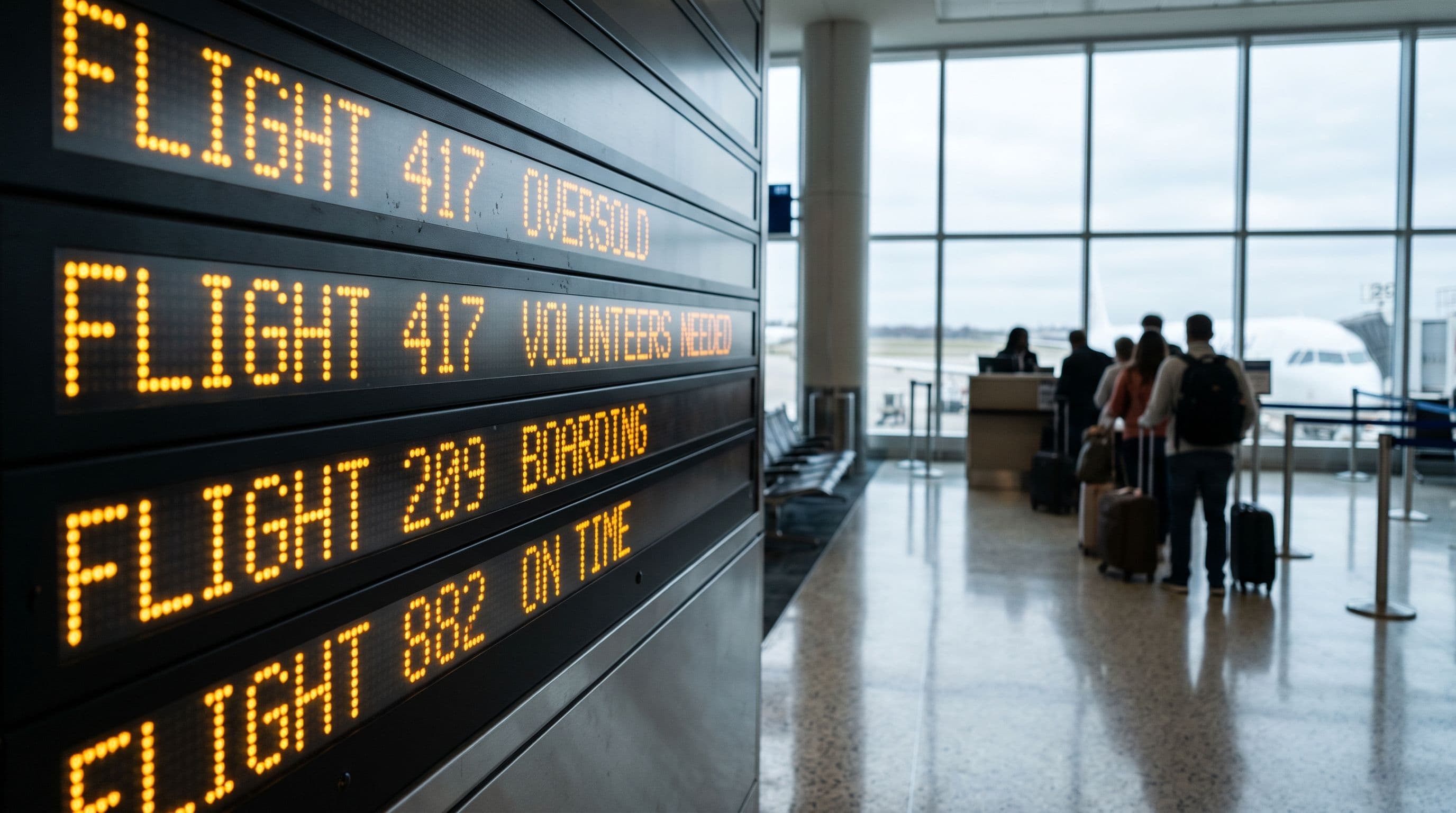
Airlines sell more seats than the plane has because some passengers never show up. Most of the time the numbers work out. When they do not, someone stays behind, and US Department of Transportation (DOT) rules decide what that person is owed.
Those rules got more generous in 2025. The DOT raised the compensation caps by nearly 40% for travel on or after January 22, 2025, from $775 to $1,075 and from $1,550 to $2,150. Yet most bumped passengers still walk away with a meal voucher and a travel credit, because they do not know the cash amount exists, or they accept the first offer at the gate. This is the 2026 guide to what you are owed, when you are owed nothing, and how to get the most from a volunteer offer.
Voluntary vs involuntary bumping: the difference that decides your payout
There are two ways to lose your seat on an oversold flight, and the money works completely differently for each.
Airlines must ask for volunteers before they bump anyone involuntarily. They must also tell volunteers whether there is a risk of being bumped involuntarily anyway, and what the involuntary compensation would be. That number is your negotiating floor.
- Voluntary bumping.The gate agent asks for volunteers and you raise your hand. You and the airline agree on a deal: cash, a voucher, miles, a hotel, a later flight. There is no legal minimum and no maximum. Whatever you accept is what you get, so negotiate before you agree.
- Involuntary bumping.Not enough people volunteer and the airline picks you. Now federal rules apply, and the airline owes you a set amount of compensation based on your fare and how late you arrive.
How much compensation do you get for being bumped in 2026?
For involuntary bumping, the payout depends on how late the airline gets you to your destination compared with your original arrival time.
"Fare" means the one-way price of the flight you were bumped from, including taxes and mandatory airline fees. On a roundtrip ticket, it is the portion of the fare for that flight. Airlines can pay more than these amounts but are not required to.
| How late you arrive | Domestic flights | International flights departing the US |
|---|---|---|
| Within 1 hour of original arrival | $0 | $0 |
| 1 to 2 hours late (domestic) / 1 to 4 hours (international) | 200% of one-way fare, max $1,075 | 200% of one-way fare, max $1,075 |
| More than 2 hours late (domestic) / more than 4 hours (international) | 400% of one-way fare, max $2,150 | 400% of one-way fare, max $2,150 |
| Airline provides no alternate flight | 400% of one-way fare, max $2,150 | 400% of one-way fare, max $2,150 |
Who qualifies (and who does not)
To be owed involuntary denied boarding compensation, all of these must be true:
The airline owes you nothing extra in these cases:
Being moved down a cabin is different from being bumped. If you are downgraded from first class to economy, for example, you are owed a refund of the fare difference rather than denied boarding compensation.
- Your flight departs from a US airport.
- You hold a confirmed reservation.
- You checked in by the airline's deadline.
- You were at the gate by the airline's boarding deadline.
- The airline cannot get you to your destination within 1 hour of your original scheduled arrival.
- Aircraft swap.The airline substitutes a smaller plane for operational or safety reasons.
- Weight and balance.Restrictions on aircraft with 60 or fewer seats.
- Small aircraft.Planes with fewer than 30 passenger seats.
- Charter flights.Flights outside an airline's regular schedule.
- Flights into the US from abroad.US rules cover departures from the US. A flight from London to New York is covered by UK rules instead, and a flight departing the EU by EU rule 261.
- Late check-in or late to the gate.Miss the deadline and the protection disappears. Check your airline's cut-off, which is often 30 to 45 minutes before departure for domestic flights and 60 minutes for international flights.
Cash or voucher? Your right to a check
Gate agents often offer a travel voucher or credit first, sometimes for a bigger number than the cash amount. For involuntary bumping, the rule is on your side: the airline must offer compensation in cash or by check. It can offer a voucher instead only if it tells you the cash amount you are entitled to and you agree to take the voucher.
A voucher is only worth taking if it is meaningfully larger than the cash, you are confident you will use it before it expires, and you have read its restrictions (blackout dates, one-time use, non-transferable). Cash is usually worth more.
- Ask: "What is the cash amount?"Make the agent say the number before you consider any voucher.
- Payment timing.Airlines must pay at the airport on the day you are bumped. If your new flight leaves before they can pay, they must pay within 24 hours.
- Get the written statement.The DOT requires airlines to give every involuntarily bumped passenger a written explanation of their rights and how the airline chose who to bump. Ask for it.
- Get your extras back.If you paid for a seat assignment, a checked bag or another optional service and do not receive it on your new flight, ask for that fee to be refunded too.
How to get the most from a volunteer offer
Volunteering is where the biggest payouts happen, because there is no cap. Major US airlines allow gate agents to offer very large amounts on badly oversold flights. The first offer at the gate is almost never the last.
- Know your floor.Work out what you would be owed if bumped involuntarily (200% or 400% of your one-way fare). Do not volunteer for less unless the rest of the deal makes up for it.
- Ask when the next confirmed seat is.A confirmed seat, not a standby listing. Being stuck on standby can turn a 3-hour delay into an overnight one.
- Ask what comes with it.Meals, a hotel for an overnight wait, ground transport, and lounge access are all fair to request.
- Ask for cash or a card, not just a voucher.Some airlines offer cash on request even when they lead with a credit.
- Read the voucher rules before you agree.Ask about the expiry date, blackout dates, whether it covers taxes, and whether it works on partner airlines or international routes.
- Wait if you can.On a heavily oversold flight, offers often rise as boarding approaches. If you are flexible and the flight is clearly overbooked, letting the first round pass can pay off. The risk is that someone else accepts first.
- Get it in writing.Before you hand over your boarding pass, confirm the amount, the form and your new flight on paper or in the app.
How to avoid being bumped in the first place
Involuntary bumping is rare on large US airlines. The DOT's monthly consumer reports put it at well under 1 passenger in 10,000. When it does happen, airlines use their own priority rules, often based on fare type, check-in time and loyalty status. Rules cannot discriminate on protected grounds such as race.
Being bumped is different from a delayed or cancelled flight, which falls under separate refund rules. For those, see what to do when your flight is delayed or canceled.
- Check in as early as possible.Check-in time is one of the most common tiebreakers. Set an alarm for exactly 24 hours before departure.
- Get a seat assignment.Passengers without assigned seats are often the first to be bumped. Basic economy fares that assign seats at check-in carry more risk.
- Avoid the last flight of the day on busy routes.If you are bumped from it, the next confirmed seat may be the next morning.
- Earn status or fly a higher fare class.Elite members and full-fare passengers are typically protected first.
- Book with a buffer.On trips with a fixed deadline (a wedding, a cruise departure, a job interview), fly a day early.
More travel guides
- What to Do When Your Flight Is Delayed or Canceled (US Rules 2026)
- The 24-Hour DOT Rule: How to Use It to Save Money
- Basic Economy vs Main Cabin: When Is Basic Actually Worth It?
- Best Credit Cards for Trip-Delay Insurance in 2026
Ready to test these savings on your next trip?
Search hundreds of global airline routes with live verified prices and 0% hidden markups.
Frequently Asked Questions
Common questions answered based on latest published policies & DOT regulations.
Resources and References
Official regulatory pages and verified data sources referenced in this guide.
Official regulatory pages and verified data sources referenced in this guide
US DOT: Bumping and Oversales
Official consumer page on eligibility, compensation amounts, exceptions and written-statement rules.transportation.gov/airconsumer/oversales
Federal Register, Oct 24, 2024: Periodic Revisions to Denied Boarding Compensation
Final rule raising caps from $775 to $1,075 and $1,550 to $2,150, effective January 22, 2025.govinfo.gov
14 CFR Part 250: Oversales
Federal regulation covering denied boarding compensation, payment timing and the right to cash or check.ecfr.gov
US DOT Air Travel Consumer Report
Monthly airline data including involuntary denied boarding rates by carrier.transportation.gov/airconsumer
US DOT Air Travel Consumer Complaint Form
Where to escalate if an airline refuses to pay.airconsumer.dot.gov
The Bottom Line
If you are bumped from a US flight against your will and land more than an hour late, you are owed 200% or 400% of your one-way fare in cash, up to $1,075 or $2,150. Ask for the cash amount before considering any voucher, get the written statement, and ask for any unused seat or bag fees back.
If you volunteer, there is no cap. Know your involuntary number, insist on a confirmed seat, and negotiate before you hand over your boarding pass. The difference between the first offer and the best one is often hundreds of dollars.
At FlySimple, we show every flight on your route and its arrival time side by side, so if plans change at the gate you can see your real options in seconds. Every fare, no clutter, no surprises.
Search a route. See every alternative flight. Know your options before the gate agent does.