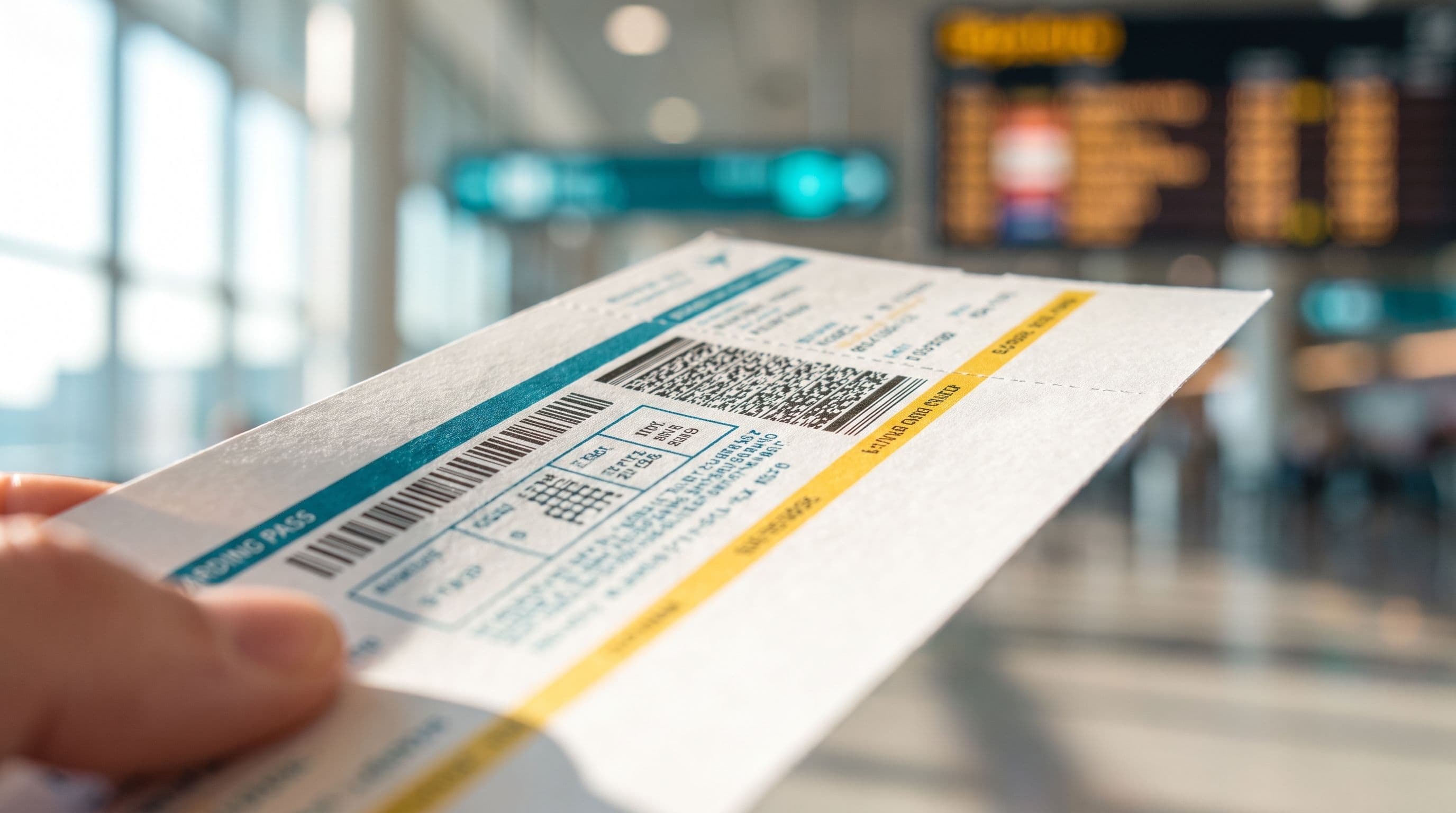
Every boarding pass follows a global IATA standard. The important fields to actually understand: PNR (your 6-character booking reference), fare class (a single letter that decides your upgrade eligibility and refund rights), boarding group or zone (the order you board), sequence number (when you checked in), TSA PRE mark (expedited security), and SSSS (secondary security screening selection, which adds 15 to 45 minutes at the checkpoint). Frequent flyer number should appear on every pass. If it does not, your miles are not being credited.
Stand at any departure gate and look at the queue. Almost everyone holds a rectangle of paper or a phone screen covered in codes, letters, numbers, and a barcode, and almost nobody can tell you what more than a quarter of it means. The name, flight number, and departure time are obvious. Everything else is airline shorthand that carries specific information, sometimes about how you can upgrade, sometimes about how you got flagged, sometimes about the fare class rules that decide what happens if the flight is cancelled.
This is the 2026 decoder for every field on a US airline boarding pass, including the four letters everyone secretly hopes they never see.
The anatomy of a boarding pass
Every boarding pass (paper, mobile, or PDF) follows the International Air Transport Association standard. That means the same fields appear on every airline's version, though the layout differs. Here is what every field means:
| Field | What it looks like | What it means |
|---|---|---|
| Passenger name | LAST/FIRST | Legal name from your ID. Must match your government ID exactly. |
| Route | JFK → LHR | Two three-letter airport codes (origin, destination). |
| Flight number | AA 100, DL 2456 | Two-letter airline code plus 1-4 digit flight number. |
| Date + departure time | 12 SEP, 18:45 | Local date and time at the departure airport. |
| Gate | B22, 47A | Boarding gate. Sometimes not printed on the pass (check the airport display). |
| Seat | 14C, 3A | Row number + column letter. A is a window on most narrowbodies. |
| PNR | 7Q2X4P | Passenger Name Record. Your 6-character booking reference. |
| Fare class | Y, B, K, M, E, N, Q | Single letter that identifies your specific fare bucket. |
| Group / zone | Group 1, Zone 3, Group A | Boarding order. Tied to fare class and status, not seat. |
| Sequence number | #23, #142 | The order you checked in. Low number = early. |
| Frequent flyer | AA-XX12345 | Your loyalty account. If missing, miles are not being credited. |
| TSA PRE | ✓ or "TSA PRE" | Expedited security. Only appears if your KTN is on the reservation. |
| SSSS | SSSS (in bold) | Secondary Security Screening Selection. Flagged for enhanced screening. |
| Barcode / QR | Aztec or PDF417 barcode | Scanned at security and the gate. Contains all of the above encoded. |
Boarding groups and zones: the order you board
The Group or Zone field determines when you board, and it is tied to your fare class and loyalty status, not your seat. Each airline uses its own scheme, and the numbering does not standardise. What Group 1 means on American is not what Zone 1 means on Delta.
The 2026 US airline breakdown:
A low group number is not just about convenience. It gives you first access to overhead bin space, which matters most on flights that are close to full.
- American Airlines: Groups 1 through 9. Group 1 is ConciergeKey and Flagship First. Groups 2-4 are elite tiers and premium cabins. Groups 5-6 are main cabin. Group 9 is Basic Economy.
- Delta: Zones 1 through 8. Zone 1 is Delta One, Diamond Medallion, and Global Services. Zone 8 is Basic Economy.
- United: Groups 1 through 6, plus Pre-Board for wheelchairs and unaccompanied minors. Group 6 is Basic Economy.
- Southwest: A, B, or C, each with numbers 1-60. Southwest has no assigned seats. Your boarding position is determined by check-in time and status.
- JetBlue: Even More Speed (paid), Mint (business), Mosaic (elite), then Groups A-E for main cabin.
- Alaska Airlines: Groups A-E. Main cabin typically boards in Group C. Basic economy (Saver) is Group E.
- Frontier and Allegiant: Zones 1-4 (Frontier) or numbered groups (Allegiant), with priority boarding sold as an add-on.
Fare class letters: the single most-underread field
The single letter under Class or Fare is the most information-dense field on your boarding pass, and almost nobody reads it. It identifies the specific fare bucket you paid for, which controls how much you can change your ticket, whether you can upgrade, how many frequent-flyer miles you earn, and what happens if the flight is oversold.
The general standard across US legacy carriers:
The practical use. When you get a boarding pass with a Y or B fare class, you often qualify for a complimentary upgrade to a higher cabin if space is available. Deeply discounted classes (Q, S, T, N, V, W on most carriers) rarely upgrade. If your goal is a bump to business class, check the fare class before you buy.
- Y: Full-fare economy. Most expensive and most flexible. Rarely booked by leisure travellers.
- B, H, K, L, M, N, Q, S, T, U, V, W: Discounted economy fare buckets. Each airline uses these differently, but the general pattern is that letters earlier in the alphabet are more expensive and more flexible; letters later are cheaper and more restrictive.
- E on American, X on Delta, N on United: Basic Economy on that specific carrier.
- W, S, P: Premium Economy on most carriers.
- C, D, I, J, R, Z: Business Class or Delta One or United Polaris.
- F, A: First Class on carriers that still offer it (mostly Delta, American on domestic transcon, and a few international routes).
TSA PRE and CLEAR indicators
The TSA PRE mark on your boarding pass grants you expedited security screening (keep shoes on, laptop in the bag, shorter line). It only appears if your Known Traveler Number (KTN) is on the reservation.
The most common reasons the TSA PRE mark is missing:
CLEAR does not appear on the boarding pass. CLEAR runs its own identity verification at the airport itself, so the mark is not on the pass. For the full comparison of when to get TSA PreCheck, Global Entry, or CLEAR, see our companion guide.
- Your KTN was not added to the booking. Log into the airline's site, find the reservation, add your KTN, and re-download the boarding pass.
- The KTN on the booking does not match the Secure Flight profile exactly. Names must match your government ID.
- You received an SSSS designation, which overrides PreCheck for that itinerary.
- You are flying an airline that does not participate in TSA PreCheck (rare in 2026, but a few small operators still do not).
SSSS: the four letters you do not want
SSSS stands for Secondary Security Screening Selection. If it appears on your boarding pass, TSA's Secure Flight system has flagged you for enhanced security screening.
What actually happens:
Why you got it:
What to do. Arrive at least 3 hours before departure. Do not check in online. Head straight to the airline counter, then to security with time to spare. See our guide on REAL ID and domestic flying for the ID rules that apply at the counter check-in.
If you get SSSS on multiple consecutive trips, apply for TSA's Redress Number at dhs.gov/tricredress. It does not guarantee removal from the Secure Flight watchlist, but it flags you as a resolved case and reduces false-positive matches on future flights.
- You cannot use online check-in or self-service kiosks. Only the airline counter can print an SSSS boarding pass.
- At security, a TSA officer directs you to a separate area. Expect a pat-down, a physical luggage inspection, and a swab test for explosive residue.
- The extra screening adds 15 to 45 minutes to your security time. Sometimes more at busy airports.
- TSA PreCheck does not exempt you from SSSS. If you are flagged, your PreCheck status is overridden for that itinerary.
- The screening happens at both departure and at any connecting US airport.
- Random selection. The most common reason. TSA's system chooses a percentage of passengers randomly, regardless of profile.
- Last-minute booking. Tickets purchased within 24 hours of departure are flagged more often.
- One-way international ticket, especially paid in cash.
- Flying to or from a country flagged by the State Department.
- Name match to a watch list, including partial matches to common names.
Frequent flyer number: where it should be and what to do if it is not
Your frequent flyer number should appear on every boarding pass for a flight on a carrier where you have an account. Usually printed near your name or at the bottom of the pass.
If it is missing, the flight is not being credited to your loyalty account. This is more common than it should be, especially when:
The fix. Log into the airline's website, find the reservation, and add your frequent flyer number. Re-download the boarding pass. If the flight has already happened, most airlines let you claim missing miles by submitting the boarding pass image and flight details within 6 to 12 months.
- You booked through an OTA (Expedia, Priceline) and did not add your frequent flyer number in the booking flow.
- You booked before you had an account and never updated the reservation.
- The airline's system did not match your name in the booking to your loyalty profile (usually because of a middle-initial or suffix mismatch).
Ready to test these savings on your next trip?
Search hundreds of global airline routes with live verified prices and 0% hidden markups.
Frequently Asked Questions
Common questions answered based on latest published policies & DOT regulations.
Resources and References
Official regulatory pages and verified data sources referenced in this guide.
The codes and standards in this article are drawn from official sources
IATA Boarding Pass Standard
The international standard that defines every boarding pass field. iata.org
TSA Secure Flight Program
Official information on how the SSSS designation is applied and what you can do about it. tsa.gov (search: Secure Flight)
DHS Traveler Redress Inquiry Program (TRIP)
If you consistently get SSSS or other travel screening issues, request a Redress Number here. dhs.gov/tricredress
Each airline's fare class guide
American, Delta, United, JetBlue, Alaska, and Southwest each publish their fare-class letter definitions in their conditions of carriage.
The Bottom Line
Every letter, number, and code on your boarding pass is telling you something specific. The ones that matter for saving money and skipping stress: the fare class letter (upgrade eligibility, refund rules), the boarding group or zone (bin space access), the TSA PRE mark (skip the standard line), the frequent flyer number (loyalty credit), and the SSSS designation (an extra hour at security if it appears).
Two minutes reading your pass before you leave home is time you save at the airport. The one code you cannot fix at the last minute is SSSS. If it appears, get to the airport early, plan for extra screening, and skip the app-based check-in.
At FlySimple, we are building the product so the honest total is priced correctly and the fare class shows in plain English before you commit. Every fare, no clutter, no surprises.
Search a route. See the real total. Understand what you actually bought before the boarding pass prints.