If your flight is cancelled or delayed 3 or more hours domestically, or 6 or more hours internationally, and you choose not to fly, you are entitled to a cash refund to your original form of payment. That is federal law, not airline goodwill. If the disruption is the airline's fault (called "controllable") and you are stuck 3+ hours waiting for a rebooking, most major US carriers commit to meal vouchers. If you end up stranded overnight, 9 of the 10 largest carriers commit to a hotel and ground transport. Weather cancellations are different: they get you the refund, but not the meals or the hotel.
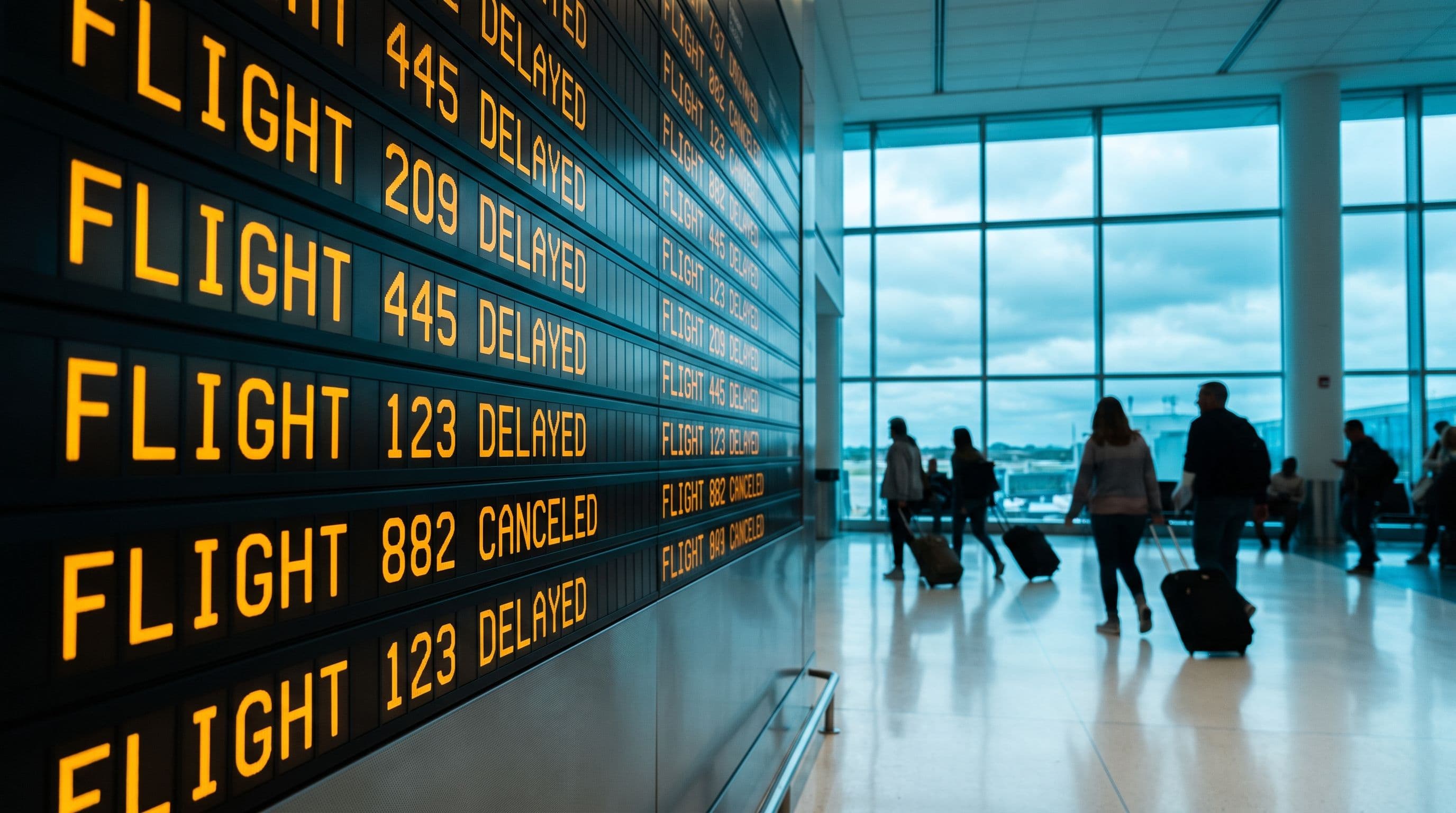
Your flight just went red on the departure board. Delayed three hours. Cancelled outright. Rebooked for tomorrow morning. Whatever the airline is telling you at the gate, the next fifteen minutes decide whether you get home tonight, whether you sleep in a hotel the airline pays for, and whether your money comes back in cash or vanishes into a voucher you will never use.
The good news is that in 2026, the rules are more on your side than they have ever been. A federal rule that took effect in October 2024 forces US airlines to give you real money back, in the original form of payment, when they cancel your flight or change it significantly and you choose not to fly. No fighting. No haggling. No voucher unless you specifically agree to one.
The bad news is that most travellers do not know the rule exists, and gate agents will not always tell you. This is the plain-English guide to what the federal rules actually say, what your airline is on the hook for beyond that, and the exact steps to take from the moment the delay hits your phone.
The moment you find out
The first fifteen minutes matter more than most travellers realise. Rebooking priority runs first-come, first-served on almost every airline, so the passenger who gets to a live agent first often gets the last seat on the next flight out.
Do these five things, in this order:
The moment you accept a rebooking that gets you to your destination, you have chosen "keep travelling." The moment you accept a voucher, you have declined the cash refund. Neither is wrong, but both are decisions, and gate agents sometimes present them as the only option when they are not.
- Screenshot the departure board. This is your evidence if you need to file a complaint later. Time-stamped, showing your flight number and the new status.
- Open your airline's app. Rebooking through the app is usually 15 to 30 minutes ahead of the gate agent, because the agent is still queuing customers. If the app offers you a rebooking that works for you, take it.
- Call the airline while you are in line. Two lines are faster than one. The phone agent has the same booking system as the gate agent and can rebook you while you wait in the physical queue.
- Ask two specific questions. First: "Is this coded as controllable or uncontrollable?" Second: "What are my rebooking options and my refund option?" Both matter, and we will explain why below.
- Do not accept anything until you have chosen. If the airline pushes a rebooking or a voucher, and you take it, you may lose the right to a cash refund. You are allowed to say "I need a minute to think" and stand aside.
Your rights under the DOT automatic refund rule
Since October 28, 2024, US airlines have been required by federal rule to give you an automatic cash refund, to your original form of payment, when any of the following happen and you decline the alternative:
"Significantly changes" is defined precisely. For a domestic US flight, a schedule change of 3 hours or more (measured against the original scheduled departure or arrival, not the last update) qualifies. For an international flight, the threshold is 6 hours. Airport swaps (the airline moves you from JFK to Newark), added connections (a non-stop becomes a one-stop), and cabin downgrades all count too.
Here is what "automatic" actually means in practice:
The catch worth noting: if you take the rebooked flight and get to your destination, the refund does not apply. The rule triggers only when you decline the alternative. That is the trade-off. You cannot both fly and get your money back under US law.
- The airline cancels your flight.
- The airline "significantly changes" your flight.
- Your checked bag is significantly delayed and you file a Mishandled Baggage Report.
- An extra service you paid for (Wi-Fi, seat upgrade, extra legroom) is not provided.
- You are downgraded to a lower class of service.
- The change creates an accessibility issue for a passenger with a disability.
- The refund goes to your original payment method. Credit card gets a credit card refund. Cash gets cash. Points and miles get points and miles.
- The airline cannot force a voucher on you. They can offer one, but a voucher is only valid if you affirmatively choose it. If you say nothing, the default is cash.
- The timeline is fixed. For credit card purchases, the airline has 7 business days to process the refund. For other payment methods, 20 calendar days.
- The refund covers everything you did not use. Base fare, taxes, and any add-ons you paid for and did not get, such as seat selection, bag fees, priority boarding, or in-flight Wi-Fi.
Controllable vs uncontrollable: the word that decides everything
Here is where the airline is on the hook for meals and hotels, and here is where they are not.
A "controllable" disruption is one within the airline's control. Mechanical issues. Crew shortages. IT system failures. A pilot who timed out on hours. A plane that showed up late from the previous leg because of routine operational stuff. These are on the airline.
An "uncontrollable" disruption is one outside the airline's control. Weather. Air traffic control ground stops. Security incidents. Bird strikes. These are on nobody.
The federal refund rule does not care about the difference. If your flight is cancelled or delayed 3+ hours (domestic) or 6+ hours (international), you get a refund either way, if you choose not to fly.
But the airline commitments to meals, hotels, and ground transport apply only to controllable disruptions. If your flight is cancelled because of a thunderstorm, you get the refund, but you do not get the hotel. If your flight is cancelled because the aircraft is broken, you get the refund and the hotel and a meal voucher.
This is the single most important question to ask at the gate: "Is this coded as controllable or uncontrollable?" Gate agents can see the answer on their internal system. If they say controllable, they owe you meals after a 3-hour wait, and a hotel if you are overnight. If they say uncontrollable, you are on your own for lodging and food.
Push back if the answer feels wrong. Airlines have been known to code a controllable delay as "weather" when the actual issue is crew scheduling. If you can see the sky is clear and FlightAware shows no ATC ground stops in your region, ask again.
Meals, hotels, and rebooking: the airline-by-airline picture
The Department of Transportation publishes the Airline Cancellation and Delay Dashboard at flightrights.gov. It lays out exactly what each of the 10 major US airlines has committed to provide when a disruption is controllable. Here is how they stack up in 2026:
Two patterns worth noticing:
Six of the ten major carriers commit to rebooking you on another airline at no additional cost: Alaska, American, Delta, Hawaiian, JetBlue, and United. The other four will try in extreme situations, but they are not obliged. This matters when your original airline has no seats for two days, because an interline agreement is often the only way to actually get home.
Nine of the ten commit to hotel accommodations and ground transport on controllable overnight cancellations. Frontier is the outlier: they explicitly do not commit to hotels or ground transport. If you are flying an ultra-low-cost carrier and the flight goes overnight for a controllable reason, expect to pay for your own room.
These are commitments, not federal law. But the DOT publicly tracks compliance, and airlines rarely violate them because doing so is public and generates enforcement attention. If you have to remind an agent that their airline committed to a meal voucher on the dashboard, you are within your rights to do so.
| Airline | Rebook same airline | Rebook other airline | Meal voucher (3+ hr) | Hotel + transport (overnight) |
|---|---|---|---|---|
| Alaska | Yes | Yes | Yes | Yes |
| Allegiant | Yes | No | Yes | Yes |
| American | Yes | Yes | Yes | Yes |
| Delta | Yes | Yes | Yes | Yes |
| Frontier | Yes | No | Yes | No |
| Hawaiian | Yes | Yes | Yes | Yes |
| JetBlue | Yes | Yes | Yes | Yes |
| Southwest | Yes | No | Yes | Yes |
| Spirit | Yes | No | Yes | Yes |
| United | Yes | Yes | Yes | Yes |
Getting rebooked on another airline (interlining)
Interlining is the single most useful thing to ask about when your airline is on a multi-day cascade.
If your flight is cancelled and the airline's next available seat is 36 hours from now, ask the gate agent this exact question: "Can you interline me on another carrier?" Under the commitments of Alaska, American, Delta, Hawaiian, JetBlue, and United, the answer is often yes at no extra cost. Under the other four carriers, it depends on the agent and the situation.
Even carriers without a formal commitment will sometimes interline in a bad-enough disruption. The trick is that they will not offer it. You have to ask.
If they refuse, and your original flight was cancelled for a controllable reason, you have a second option: buy the ticket on the other airline yourself, keep the receipt, and file for reimbursement through your original airline's customer relations team. Success is not guaranteed, but the reimbursement rate on documented controllable-cancellation claims is much higher than most travellers expect.
If you paid with a credit card that carries trip delay insurance (many premium travel cards do), read the fine print. Chase Sapphire Preferred, Chase Sapphire Reserve, Amex Platinum, and Capital One Venture X all cover reasonable reimbursements for meals, hotels, and rebooking when a covered delay hits a certain threshold, usually 6 or 12 hours. This is separate from the airline's obligations and stacks on top of them.
Domestic vs international rules
The DOT refund rule applies to any flight that operates to, from, or within the United States, regardless of which airline you are flying. If you booked a Lufthansa flight from Chicago to Frankfurt and it is cancelled, the DOT rule covers your refund.
But the thresholds shift when the itinerary is international:
If you are on an international itinerary with more than one carrier (a codeshare, an interline, or a mixed booking), the operating carrier's rules typically apply to that segment. If the flight is operated by a European carrier or departs from a European airport, EU rules may also apply, and they are often more generous than the US rule. That is worth its own section.
- Domestic: 3 hours or more of delay against the original schedule, or a cancellation, triggers refund rights if you decline the alternative.
- International: 6 hours or more. Same triggers otherwise.
- Bag delay refunds: 12 hours domestic, 15 to 30 hours international depending on segment length. File a Mishandled Baggage Report to activate.
EU 261 vs the US: when European rules cover your US-booked flight
EU 261/2004 is the European Union's passenger rights regulation, and on many US-to-Europe or Europe-to-US flights, it is more generous than the US rule. It applies to:
If you booked United from JFK to Dublin and the flight is cancelled, EU 261 does not apply, because United is not an EU carrier and JFK is not an EU airport. You are on US rules only.
If you booked Aer Lingus JFK to Dublin and the flight is cancelled, EU 261 applies, because Aer Lingus is an EU carrier arriving in the EU. You get both the US refund rights and EU 261 protections.
If you booked United from Dublin back to JFK and the flight is cancelled, EU 261 applies, because the flight departed from an EU airport. You get EU 261 protections plus US rules.
What EU 261 adds beyond the US rule:
The US rule does not include cash compensation for delays. It only gives you a refund if you do not fly. EU 261 gives you cash even if you take the delayed flight to your destination. On a covered flight, that is real money worth claiming, and airlines will not offer it. You have to file.
For a codeshare where a US carrier's flight number is operated by an EU carrier (or vice versa), the operating carrier's rules apply, not the marketing carrier's. Check your ticket for the "operated by" line.
- Any flight departing from an EU airport, regardless of which airline operates it.
- Any flight arriving in the EU on an EU carrier (Lufthansa, KLM, Air France, Aer Lingus, Iberia, ITA, TAP, and so on).
- Cash compensation for long delays. €250 for short-haul, €400 for medium-haul, and €600 for long-haul (over 3,500 km) when the delay at final destination is 3 hours or more and the cause is within the airline's control.
- Care during long delays. Meals, refreshments, communication, and hotel accommodation when the wait is long, regardless of the airline's own commitments.
- Rerouting at the airline's expense, including on another airline if the original carrier has nothing suitable.
What to say at the gate
Gate agents are dealing with hundreds of stressed travellers. They are not your enemy, and they are working with a computer system that constrains what they can offer. The travellers who get taken care of are the ones who ask specific questions calmly.
Here is the script.
Opening line, regardless of what happened:
"Hi. I'm on flight [number]. I understand it is cancelled. Can you confirm whether this is coded as controllable or uncontrollable?"
If the answer is controllable:
"Under your airline's DOT dashboard commitments, I understand I am entitled to a meal voucher after a 3-hour wait, and hotel and ground transport if I am stuck overnight. Can we start with the meal voucher? I'd also like to know my rebooking options, including interlining on another carrier if your next available flight is more than 12 hours out. If none of the rebooking options work for me, I'd like the cash refund to my original payment method."
If the answer is uncontrollable:
"Understood. Can you confirm my rebooking options? And if none of them work for me, I'd like the automatic cash refund to my original payment method."
Two things to notice about that script.
You are not asking whether you have these rights. You are telling the agent you know you do, calmly, and asking what they can do next. That framing gets a different response than "what are you going to do for me?"
You are also naming the phrase "original payment method." That closes the door on a voucher offer, which is the airline's first choice because vouchers expire and cash does not.
Filing a DOT complaint that actually works
If the airline refuses to honour the rules, the DOT complaint form at transportation.gov/airconsumer is the escalation path that gets results. Airlines are required to respond to DOT complaints within 60 days, and repeated complaints against a specific carrier factor into DOT enforcement decisions.
File a complaint if:
What to include:
The DOT does not adjudicate individual disputes on the spot, but it does force the airline to respond in writing, and airlines settle a very high percentage of DOT complaints in the traveller's favour.
Two other levers worth knowing.
Credit card chargeback. If you paid with a credit card and the airline refused to refund a cancelled flight, you can dispute the charge with your card issuer. Under most cardholder agreements, "service not provided" is a valid dispute reason, and card issuers rule in the cardholder's favour more often than not when the facts are clear.
Small claims court. For international itineraries covered by EU 261 where the airline is stonewalling, small claims court against the airline's US subsidiary has a strong success rate. Most airlines settle out of court once they are served.
- The airline denies you a refund you are legally entitled to under the DOT rule.
- The airline coded a controllable disruption as "weather" and you have evidence otherwise (FlightAware records, weather reports, other airlines flying).
- The airline offered only a voucher and refused a cash refund when you asked.
- The airline failed to honour a dashboard commitment (meal voucher, hotel) on a confirmed controllable disruption.
- Your booking reference and flight numbers.
- Screenshots of the departure board, the airline app showing the status, and any written communications from the airline.
- A timeline of what you asked for and what the airline said.
- Copies of any receipts if you paid out of pocket for meals, a hotel, or a replacement ticket.
Ready to test these savings on your next trip?
Search hundreds of global airline routes with live verified prices and 0% hidden markups.
Frequently Asked Questions
Common questions answered based on latest published policies & DOT regulations.
Resources and References
Official regulatory pages and verified data sources referenced in this guide.
The rules and figures in this article come from official sources
Bookmark these to check the current version of any rule yourself.
U
S. Department of Transportation, Aviation Consumer Protection. The authoritative source on US airline consumer rules, including the automatic refund rule, complaint filing, and the 24-hour reservation requirement. transportation.gov/airconsumer
DOT Airline Cancellation and Delay Dashboard (flightrights
gov). The official comparison of every major US airline's commitments on controllable cancellations and delays: rebooking, meals, hotels, and ground transport. transportation.gov/airconsumer/airline-cancellation-delay-dashboard
DOT Final Rule on Airline Refunds and Other Consumer Protections (April 26, 2024)
The full federal rule text defining automatic refund triggers, significant change thresholds, refund timelines, and ancillary fee refund rules. federalregister.gov (search: airline refunds final rule 2024)
European Commission, Air Passenger Rights (EU Regulation 261/2004)
The official EU regulation on passenger rights for delays, cancellations, and denied boarding, including the distance-based compensation table. europa.eu (search: air passenger rights)
Bureau of Transportation Statistics, On-Time Performance and Cancellation Data
Monthly figures on airline delay and cancellation rates by carrier and route, useful for evaluating an airline's reliability record before you book. bts.gov
The Bottom Line
The gap between what you are legally entitled to and what airlines tell you at the gate has closed considerably since the DOT's 2024 rule. Cash refunds for cancellations and significant changes are automatic now. Meal vouchers and hotels on controllable disruptions are public commitments the DOT tracks. Interlining on six of the ten majors is a formal commitment, and it is often available on the other four if you ask.
The travellers who get taken care of are the ones who know the vocabulary (controllable, significant change, original form of payment, interline) and use it calmly at the counter. The travellers who take the first offer the airline makes usually leave money and comfort on the table.
If you booked directly with a US airline, you have layered safety nets: the 24-hour DOT rule, the automatic refund rule, the airline's dashboard commitments, EU 261 if you were flying to or from Europe, and your credit card's travel protection.
At FlySimple, we are building the product so both the fare and the fine print are visible before you book. Every fare, no clutter, no surprises. And when things go sideways, the safety net is easier to reach because you knew it existed before the delay hit.
Search a route. See the real total. Know your rights before the delay hits, not after. That is it.