
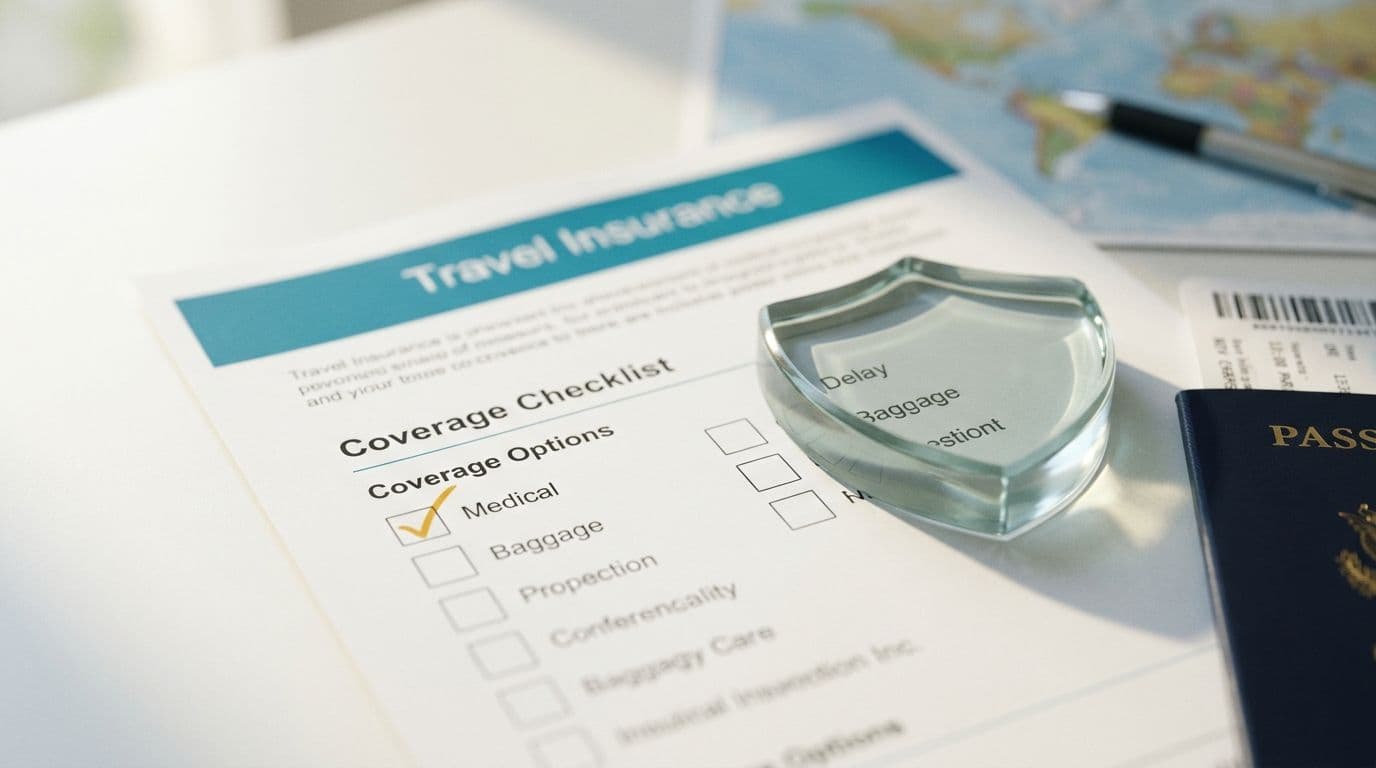
You need standalone travel insurance if: (1) you are travelling internationally (your US health insurance almost certainly does not cover you abroad, and Medicare never does), (2) your trip includes non-refundable prepaid costs over $2,000, or (3) you are doing anything active or remote (hiking, skiing, diving, cruise, developing country). You can skip it if: your trip is fully refundable, domestic, and your health insurance covers you in the destination state. Your credit card covers trip delay, trip cancellation (narrow reasons), and rental car CDW. It does NOT adequately cover emergency medical care or medical evacuation abroad.
A medical evacuation from overseas costs $25,000 to $250,000. A broken ankle in Paris costs $5,000 to $15,000 at a private hospital. A cancelled non-refundable trip to Japan costs whatever you paid for the flights, hotels, and tours. Your credit card covers none of the medical and only some of the cancellation.
Travel insurance costs 4 to 10% of your total trip cost. On a $3,000 vacation, that is $120 to $300 for comprehensive coverage including medical, evacuation, cancellation, and baggage. This is the decision guide: five questions that tell you whether you need it, what your credit card already covers, and the one gap that catches most travellers off guard.
The 5-question decision flowchart
Most international travellers need standalone travel insurance (Q1 sends you there immediately). Most domestic travellers with a premium credit card and health insurance can skip it (Q3 and Q4 clear them). The grey zone is domestic trips with high non-refundable costs (Q2) and active or remote travel (Q5).
| Question | If yes | If no |
|---|---|---|
| 1. Are you travelling internationally? | Buy travel insurance. Your US health insurance almost certainly does not cover you abroad. Medicare never does. A hospital bill or evacuation without coverage can exceed $100,000. | Move to Q2. |
| 2. Does your trip include $2,000+ in non-refundable costs? | Buy trip cancellation coverage (standalone or comprehensive). If you get sick, injured, or face a covered emergency, you lose that money without it. | Move to Q3. |
| 3. Does your credit card include trip cancellation and trip delay? | Your card covers the cancellation and delay risk. Move to Q4. | Buy comprehensive travel insurance (it includes trip cancellation + medical). |
| 4. Does your health insurance cover you in the destination state or country? | Your health is covered. Move to Q5. | Buy travel medical insurance (standalone or comprehensive). |
| 5. Are you doing anything active, remote, or on a cruise? | Buy comprehensive with medical evacuation. Evacuation from a mountain, a cruise ship, or a remote area costs $25,000 to $250,000. | You are likely covered by your credit card + health insurance. Skip standalone travel insurance. |
What your credit card covers vs what it does not
This is the table that every credit card company hopes you never see. Your premium travel card covers some things well and misses others entirely:
The critical gap is emergency medical and evacuation. Most credit cards provide $0 in emergency medical coverage abroad and $0 in medical evacuation. The Chase Sapphire Reserve includes up to $100,000 in emergency evacuation, which is better than most cards but still below the $250,000 to $1,000,000 that a standalone plan provides. A medical evacuation from a cruise ship or a remote international location routinely exceeds $100,000.
For the full breakdown of which cards cover trip delay and at what threshold, see our guide on the best credit cards for trip-delay insurance.
| Coverage type | Credit card (typical) | Standalone travel insurance |
|---|---|---|
| Trip cancellation | Up to $10,000 (narrow covered reasons) | Up to $50,000+ (broader covered reasons) |
| Trip interruption | Up to $10,000 | Up to $50,000+ |
| Trip delay | $500 per ticket after 6-12 hr delay | $500 to $2,000 per person |
| Emergency medical | $0 to $2,500 (most cards: $0) | $50,000 to $500,000 |
| Medical evacuation | $0 to $100,000 (most cards: $0) | $250,000 to $1,000,000 |
| Rental car CDW | Up to vehicle value (primary or secondary) | Usually included in comprehensive |
| Baggage loss/delay | $1,500 to $3,000 | $1,000 to $3,000 |
| Cancel for any reason | Not available | Optional add-on (75% reimbursement) |
| Pre-existing conditions | Not covered | Covered with time-sensitive enrolment |
| Adventure activities | Not covered | Covered on many comprehensive plans |
| Cost | $0 (included with annual fee) | 4 to 10% of trip cost |
What it costs when you do not have it
The numbers that make the 4 to 10% premium feel cheap:
The asymmetry is clear. Travel insurance costs $120 to $300 on a $3,000 trip. The downside risk without it is $15,000 to $250,000 on a medical emergency abroad. For international trips, the math is not close.
| Scenario | Cost without insurance | With $200 comprehensive policy |
|---|---|---|
| Broken leg in Europe (hospital + surgery) | $15,000 to $40,000 | Covered up to policy limit |
| Medical evacuation from cruise ship | $20,000 to $50,000 | Covered up to $250K to $1M |
| Medical evacuation with repatriation (Asia) | $50,000 to $250,000+ | Covered up to policy limit |
| Non-refundable trip cancelled (illness) | $3,000 to $15,000 | Covered up to policy limit |
| Missed connection causing overnight + rebook | $300 to $1,500 | Covered (credit card may also cover) |
| Lost luggage, airline pays max $3,800 (domestic) | $0 (airline covers) | Not needed (airline covers) |
| Stolen passport + emergency replacement travel | $500 to $2,000 | Covered on most comprehensive plans |
When you can safely skip travel insurance
- Domestic US trip, fully refundable bookings, good health insurance. Your credit card covers trip delay and cancellation. Your health insurance covers medical. Nothing is at risk.
- Short domestic weekend trip under $500 total. The cost of insurance (4 to 10% = $20 to $50) is not worth the coverage on a trip this small. Self-insure.
- You already have comprehensive coverage through your employer or an annual travel insurance plan. Some employers include travel medical as a benefit. Some frequent travellers buy annual multi-trip policies ($300 to $600/year for unlimited trips) that are cheaper than buying per-trip.
- Road trip with no flights and no hotels. If you are driving your own car and sleeping at home or at a friend's place, there is nothing to insure. Your auto insurance covers the car. Your health insurance covers you.
When you absolutely need it
- Any international trip. US health insurance (including most PPO and HMO plans) does not cover care outside the US, or covers it at a fraction of the cost. Medicare provides zero international coverage. A hospital stay in London, Tokyo, or Mexico City is a cash-pay event without travel insurance.
- Cruise. Medical facilities on cruise ships are limited. Evacuation from a ship at sea to the nearest hospital costs $20,000 to $50,000. Most credit cards do not cover medical evacuation from a cruise.
- Adventure travel (skiing, hiking, diving, cycling tours). Standard health insurance often excludes injuries from adventure activities. Travel insurance comprehensive plans typically include them.
- Trip with $5,000+ in non-refundable prepaid costs. Guided tours, safari packages, resort deposits, non-refundable airline tickets. If you cancel for a covered reason, the insurance reimburses up to the policy limit. Your credit card's trip cancellation cap ($5,000 to $10,000 on most cards) may not cover the full amount.
- Travellers over 65. Higher medical risk abroad, and many credit card travel benefits exclude or limit coverage for travellers over a certain age. Standalone travel medical insurance is available at every age with appropriate pricing.
- Travellers with pre-existing conditions. Most credit cards exclude pre-existing conditions entirely. Standalone travel insurance covers them if you enrol within 14 to 21 days of your initial trip deposit (the 'time-sensitive' or 'look-back' window).
Types of travel insurance: which one to buy
- Comprehensive travel insurance ($120 to $300 on a $3,000 trip). Covers everything: trip cancellation, trip interruption, trip delay, emergency medical ($50K to $500K), medical evacuation ($250K to $1M), baggage loss/delay. This is the default choice for most international trips.
- Travel medical only ($40 to $100 on a $3,000 trip). Covers emergency medical and evacuation only. No trip cancellation, no delay, no baggage. Best for travellers whose credit card already covers cancellation and delay but does not cover medical.
- Cancel for Any Reason (CFAR) add-on (+40 to 60% above base premium). Reimburses 75% of non-refundable trip costs if you cancel for ANY reason, not just covered reasons. Must be purchased within 14 to 21 days of initial trip deposit. Best for expensive trips where you want maximum flexibility.
- Annual multi-trip policy ($300 to $600/year). Covers unlimited trips during the year with per-trip limits. Best for travellers who take 3+ international trips per year. Cheaper than buying per-trip coverage each time.
How to buy the right policy
- Compare on Squaremouth.com or InsureMyTrip.com. Both are free comparison engines that show policies from multiple insurers side by side, filtered by your trip details.
- Buy within 14 to 21 days of your first trip deposit. This is the window for pre-existing condition coverage and CFAR eligibility. Miss it and both options disappear.
- Match the medical coverage to your destination. A $50,000 medical limit is adequate for most European countries with public hospitals. A $100,000+ limit is safer for the US, Japan, or any country with high private medical costs.
- Check evacuation limits. $100,000 minimum for any international trip. $250,000+ for cruises, remote destinations, or adventure travel.
- Read the covered reasons for cancellation. Standard policies cover illness, injury, death of a family member, jury duty, and natural disasters. They do not cover "I changed my mind" or "work got busy." CFAR covers everything but reimburses only 75%.
Ready to test these savings on your next trip?
Search hundreds of global airline routes with live verified prices and 0% hidden markups.
Frequently Asked Questions
Common questions answered based on latest published policies & DOT regulations.
Resources and References
Official regulatory pages and verified data sources referenced in this guide.
The coverage data and cost estimates in this article come from these 2026 sources
NerdWallet: Is Travel Insurance Worth It? (2026)
Comprehensive guide with cost estimates and coverage comparisons. nerdwallet.com
Squaremouth Travel Insurance Comparison
Free comparison engine showing policies from multiple insurers. squaremouth.com
InsureMyTrip
Second major comparison site with user reviews and plan filtering. insuremytrip.com
Allianz Travel Insurance: Credit Card vs Travel Insurance
Side-by-side coverage analysis. allianz.com
Orcaig: Is Travel Insurance Worth It in 2026? Independent analysis with medical evacuation cost data
orcaig.com
Medicare
gov. Official confirmation that Original Medicare does not cover care outside the US. medicare.gov
The Bottom Line
Your credit card covers trip delay and cancellation well. It does not cover emergency medical care or evacuation abroad. That single gap is the reason travel insurance exists, and it is the gap that costs uninsured travellers $25,000 to $250,000 when something goes wrong overseas.
For domestic trips with refundable bookings and good health insurance: skip it. For international trips of any kind: buy it. The cost is 4 to 10% of the trip. The downside risk without it is your retirement savings. That math settles itself.
At FlySimple, we are building the product to show the honest total on every trip and to flag the protections you need before you book. Every fare, every stay, no clutter, no surprises.
Search a trip. See the real total. Know what coverage you need before you fly.